
MEET Juan, YOUR spanish INSTRUCTOR
Juan, standing here with the amazing Alhambra at his back in Granada, Spain, is an accomplished visual artist and Ontario certified teacher with a Bachelor of Fine Arts and a Bachelor of Education from the University of Manitoba.
In September 2000, Juan opened El Estudio, Spanish Language Academy in Winnipeg, Manitoba, with the purpose of securing a working position for himself with a flexible schedule that would allow him to pursue his career as a visual artist.
Juan taught and shared his passion for his language with his students for 12 years until he closed his academy and moved to Edmonton, Alberta, where he opened iSpeakSpanish, and later moved to Kitchener with his family.
Juan has a 25 year long teaching experience. He has taught Spanish to hundreds of students in Winnipeg, Edmonton, and in Kitchener to children in the regular school system and to adults in his Spanish private school.
When you take lessons with Juan at iSpeakSpanish, you are not only learning Spanish in a fun, relaxing, and friendly class, but your are also supporting the artistic and cultural engine of your city.
To see samples of Juan’s work on painting, photography, sculptural ceramics, video, and digital media visit his website at www.juanlopezdabdoub.com
LA ALHAMBRA
The Alhambra, known for its intricate Islamic architecture and gardens, is a a stunning palace and fortress complex in Granada, Spain.
The name Alhambra, like many names and words in the Spanish vocabulary, originates from the Arabic language.
From 711 to 1492, Spain was under Muslim rule. For nearly eight centuries, Arabic was the dominant language of the Iberian peninsula. This historical presence left a big mark on the evolution of the Spanish culture, religion, and language.
Words like aceite (oil), berenjena (eggplant), ojalá (hopefully), zanahoria (carrot), albóndiga (meatball), almohada (pillow), tarea (homework), and approximately four thousand more words are from Arabic.
language and culture
According to linguists, the way people think of the world is influenced directly by the vocabulary they use to talk about it. People can perceive only aspects of the world, they argue, for which their language has words. The acquisition of a new language, accordingly, can change the way people see the world, enabling them to have a wider perspective of life.
“I like to bring the cultural aspect of the Hispanic world when I teach Spanish because cultural awareness makes language learning stick and memorable. It is difficult to learn a new language without understanding the values, beliefs, perspective, and way of life of its people.
TWO MADONNAS. Oil on canvas. 60″ x 48″. Juan Lopezdabdoub
Amazing!
“Juan is an amazing Spanish language teacher. I studied Spanish in Central America and really struggled to learn. Coming back home to Kitchener, I found Juan’s school. He is very professional, and he actually has a teaching degree. He quickly assessed my level and made a plan for me to continue learning. I progressed much faster studying with Juan than I did abroad. Juan is very patient. He also offers a flexible schedule, which was very important to me. Not only is Juan a great teacher, but he is also an interesting, and really cool person whom was great to connect with. I would HIGHLY recommend Juan to anyone looking to learn Spanish!”
MARK MATTHEEW, Kitchener
Incredibly knowledgeable!
I reached out to Juan to begin learning Spanish from scratch (after some app exercises), with a strong focus on conversation, and I couldn’t have asked for a better experience. From the very beginning, he quickly assessed my level and tailored both the course materials and pace to suit my needs.
The program is thoughtfully structured, combining personalized coursework with an extensive and rich library of materials, along with online lessons where we review homework and build on new topics. I especially appreciate how Juan balances “formal” language with real-world spoken Spanish, and how he weaves in cultural context and the history of Spanish-speaking countries—this makes the learning process far more engaging and meaningful.
Another standout aspect is the breadth of topics we explore. Juan is incredibly knowledgeable across many disciplines, which keeps lessons interesting and dynamic. He brings a professional yet friendly demeanor, a great sense of humor, and a genuine interest not only in his students’ progress in Spanish, but also in their overall growth and success.
On top of that, he is honest, flexible, highly responsive, and offers very competitive pricing. I would highly recommend Juan to anyone looking for a well-rounded, engaging, and personalized approach to learning Spanish.
DONATA GIERCZYCKA. Kitchener
Best in Town!
NICHOLAS BYAM, Kitchener
don simon
Mix media on canvas board. 47′ X 30″. Juan Lopezdabdoub
SIMON BOLIVAR Y PALACIOS
Venezuelan military and political leader, Simón Bolivar y Palacios, played a key role in the Hispano American successful struggle for independence from the Spanish Empire, and is considered of the most influential political figures in Latin América.
Bolivar’s political legacy has been massive and his figure is very important in South American political life. Equestrian statues of Simón Bolivar mounting Palomo, his famous horse, and holding his sword in stance of war, are common monuments in all Latin American central plazas and parks. Here in the painting above by Juan, we see Bolivar’s statue in the background, as his namesake, Don Simón, passing by in his way to the market, stops his donkey to ask the painter, “Pero y que pensás que estás haciendo ahi parado vos pintando gente sin pedir permiso?”
ORISHAS.
Mix media on canvas board. 47″x29.5″
Juan Lopezdabdoub.
Rooted in the religious traditions of the Yoruba people who were brought to Cuba during the transatlantic slave trade, Orisha dances are a vital part of the Afro-Cuban culture.
These dances are expressions of devotion to the Orishas, which are deities or divine forces in the Yoruba religion.
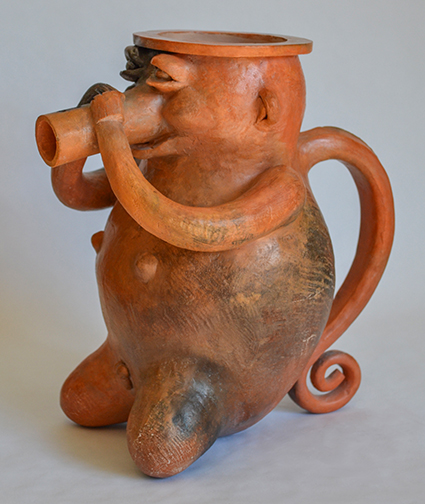
EL CIPITIO
Hand built stoneware. Juan Lopezdabdoub.
EL Cipitío is a legendary character from Salvadorean folklore revolving around la Siguanaba and el Cadejo legends. He is generally portrayed as an 8- to 10-year-old boy with a large conical hat and a potbelly. His name is taken from the Nahuatl word for child: cipit or cipote.
According to the legend, el Cipitío is the product of a forbidden romance between Sihuehuet, goddess of the moon, commonly known as la Siguanaba, and el Lucero de la Mañana (Lucifer).
Cipitío is said to enjoy eating ashes, throwing pebbles at beautiful ladies, and preferring to eat a variety of banana called Guineo Majoncho. He can also teleport himself anywhere he wants.
A couple of short stories with this character can be found in the book Cuentos de Cipotes by the Salvadorean writer and poet Salarrué (Salvador Salazar Arrué) .